![[Experimental]](figures/lifecycle-experimental.svg)
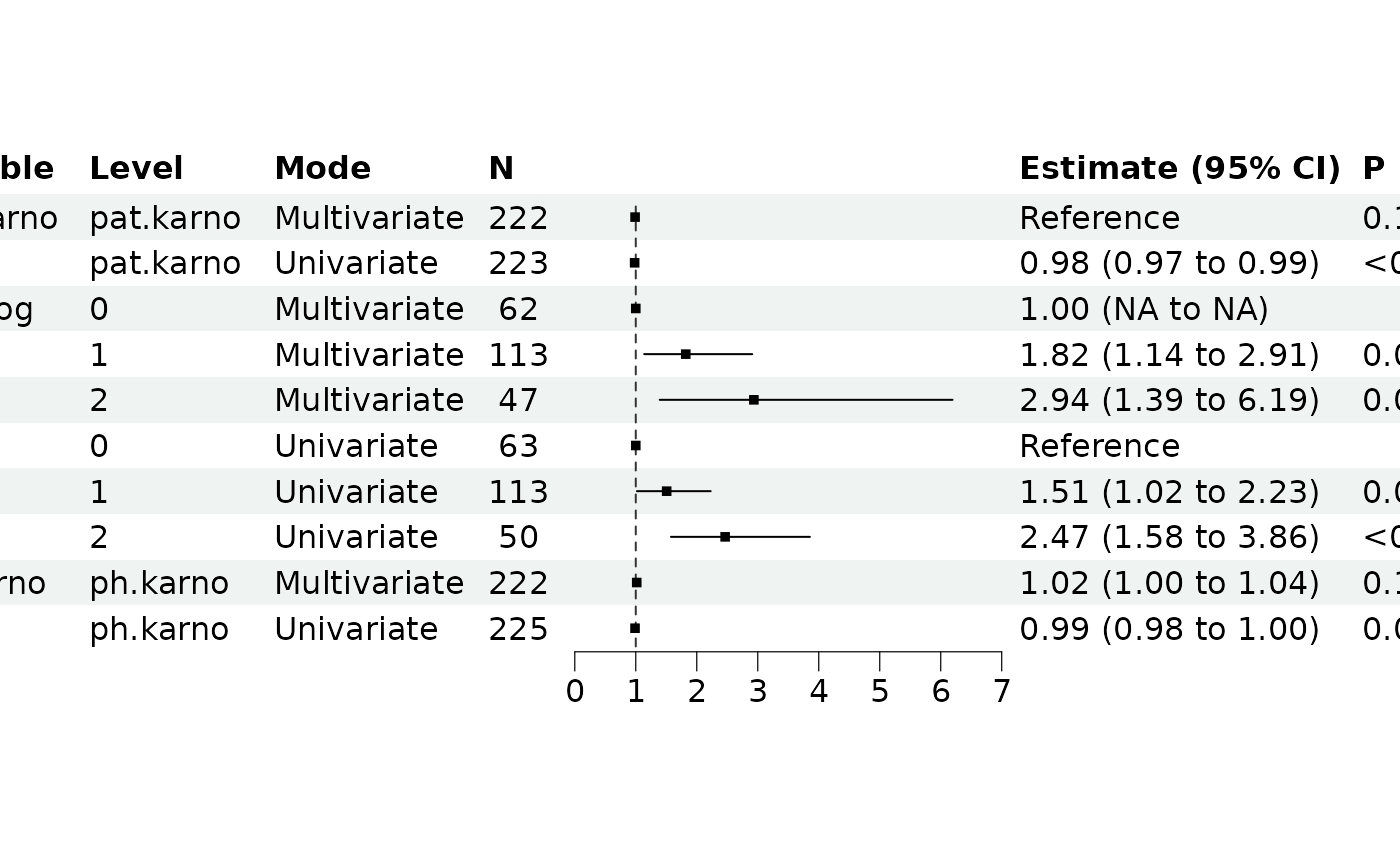
This function builds both univariate models (each predictor separately) and a multivariate model (all predictors together), then combines the results for comparison. This is useful for understanding how predictor effects change when accounting for other variables.
Arguments
- data
A
data.framecontaining all necessary variables for analysis.- y
Character vector specifying dependent variables (response variables). For GLM models, this is typically a single character (e.g.,
"outcome"). For Cox-PH models, it should be a length-2 vector in the formatc("time", "status").- x
Character vector specifying focal independent terms (predictors). These will be modeled both individually (univariate) and together (multivariate).
- x2
Character vector specifying control independent terms (predictors, optional). These are included in all models (both univariate and multivariate).
- method
Method for model construction. See
br_set_model()for details.- ...
Additional arguments passed to
br_run().- n_workers
Integer, indicating number of workers for parallel processing.
- model_args
A list of arguments passed to
br_set_model().- run_args
A list of arguments passed to
br_run().
Value
A list with class breg_comparison containing:
univariate: breg object with univariate model resultsmultivariate: breg object with multivariate model resultscombined_results: Combined results data frame with amodecolumncombined_results_tidy: Combined tidy results with amodecolumn
See also
Other br_compare:
br_show_forest_comparison()
Examples
# Compare univariate vs multivariate for Cox models
lung <- survival::lung |>
  dplyr::filter(ph.ecog != 3)
lung$ph.ecog <- factor(lung$ph.ecog)

comparison <- br_compare_models(
  lung,
  y = c("time", "status"),
  x = c("ph.ecog", "ph.karno", "pat.karno"),
  x2 = c("age", "sex"),
  method = "coxph"
)
#> Building univariate models...
#> exponentiate estimates of model(s) constructed from coxph method at default
#> Building multivariate model...
#> exponentiate estimates of model(s) constructed from coxph method at default

# View combined results
comparison$combined_results_tidy
#> # A tibble: 4 × 9
#>   Focal_variable term    estimate std.error statistic p.value conf.low conf.high
#>   <chr>          <chr>      <dbl>     <dbl>     <dbl>   <dbl>    <dbl>     <dbl>
#> 1 ph.karno       ph.kar…    0.988   0.00595     -2.06 3.96e-2    0.976     0.999
#> 2 pat.karno      pat.ka…    0.981   0.00568     -3.30 9.64e-4    0.971     0.992
#> 3 ph.karno       ph.kar…    1.02    0.00984      1.59 1.12e-1    0.996     1.04
#> 4 pat.karno      pat.ka…    0.989   0.00723     -1.55 1.21e-1    0.975     1.00
#> # ℹ 1 more variable: mode <chr>

# Create forest plot comparison
br_show_forest_comparison(comparison)